

Translations
Auto-translation of mismatched-language content, the review workflow, and language-enforcement guardrails.
orboto's UI ships in multiple languages out of the box - each user picks their own from a dropdown in their Profile, independent of anything on this page. Content - ticket titles and descriptions, comments, docs - is a separate concern: it can be machine-translated when it arrives in a different language than the workspace expects, if an AI provider is configured, and it feeds features that work best when content is linguistically consistent.
Why this matters
orboto's search (full-text search with stemming and stopwords) and its AI features (semantic search, duplicate detection, Ask-Docs) both assume the workspace's content is written in one consistent language. A workspace with tickets scattered across five languages doesn't just look untidy - full-text search stops finding obvious matches because its stemming rules are language-specific, and semantic-similarity comparisons between a German ticket and its near-duplicate English twin are far weaker than between two tickets in the same language. The controls on this page exist to keep content uniform without forcing everyone who writes a ticket to personally translate it first.
Setting the expected language
Admin -> System settings -> Workspace language sets the language content is expected to be written in. This drives three related controls, all under System settings:
- Auto-translate new tickets to workspace language (off by default) - when a new ticket is written in a different language, orboto translates the title and description via the configured AI provider and keeps the original text as a comment, so nothing is lost. Requires AI to be configured; without it, mismatched tickets are only flagged with a warning, not translated.
- Reject tickets not written in the workspace language (off by default) - when on, a create/update whose detected language differs is blocked (422) instead of just warned, unless the caller passes an explicit override. This is a guardrail an agent can override per-request with a reason, not a hard lock.
- Both interact: auto-translate resolves a mismatch before the strict guardrail would reject it, when both are on.
The review workflow
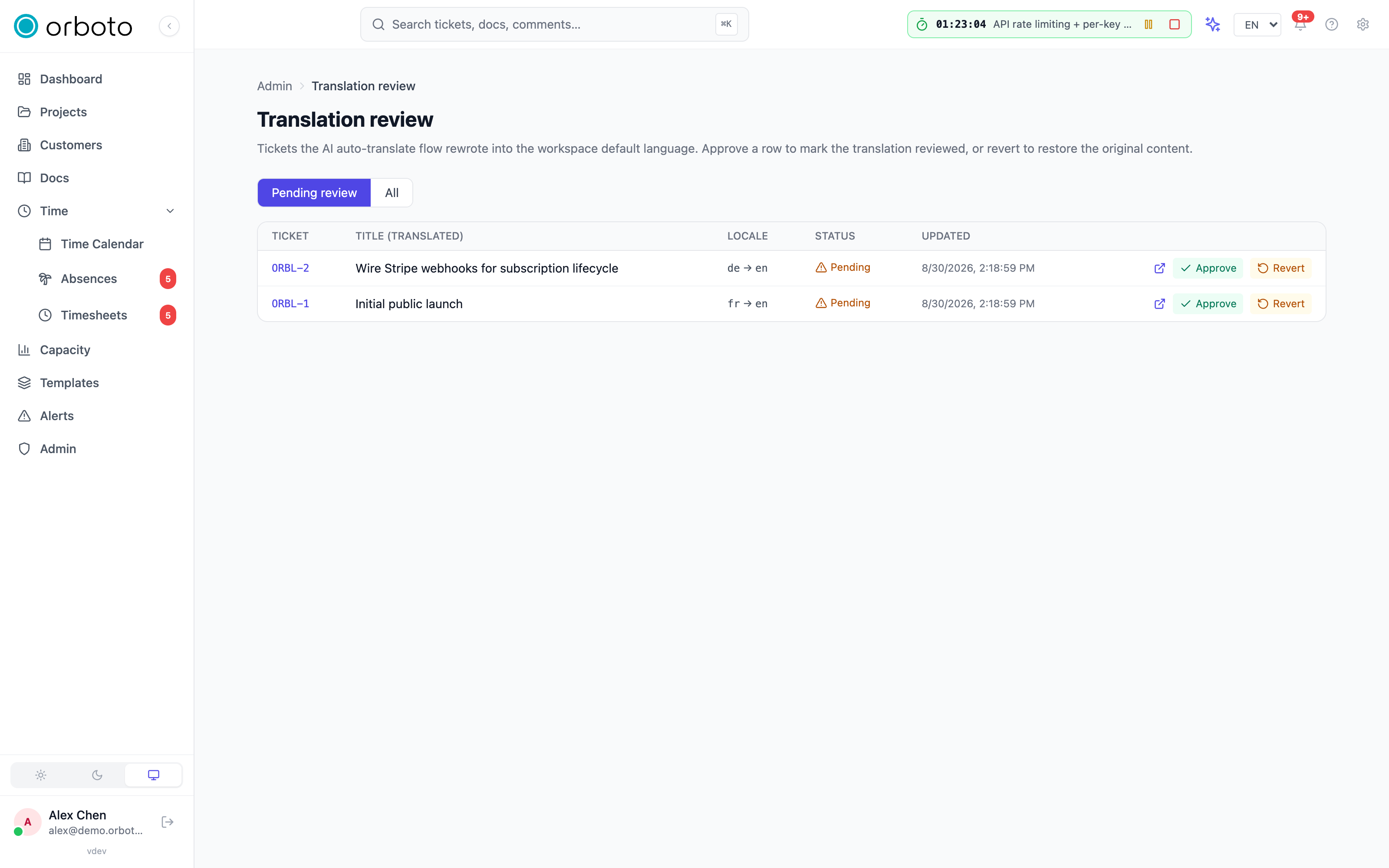
Admin -> Translations lists every ticket the auto-translate flow rewrote, defaulting to the pending queue (all reviewed rows are still visible under All). Each row shows the ticket, its translated title, the source -> target locale pair, and review status. Per row:
- Approve marks the translation reviewed - it's already being served to users reading in the target language; approving just closes the review loop.
- Revert restores the original pre-translation content and removes the auto-translated marker - use it when the machine translation materially changed meaning or tone.
- Open ticket jumps straight to the ticket for full context.
Translations regenerate lazily: if the source text changes after translation, the next request produces a fresh translation rather than serving a stale one - so an edited ticket's translation catches up automatically, no manual re-run needed.
Troubleshooting
- Translations never appear even with auto-translate on - confirm an AI provider is actually configured and reachable (Admin -> AI settings); auto-translate silently produces nothing without one, it does not error loudly on every affected ticket.
- A ticket keeps getting flagged as the wrong language - short, jargon-heavy text (a one-line title, mostly proper nouns or code) is where automatic language detection is least reliable. If this repeats across a batch (e.g. an import), it's worth reviewing whether that batch's content is actually the expected language before trusting the detector on it.
- Strict enforcement is blocking legitimate mixed-language work - an agent or integration can override per-request, but if this is a recurring, legitimate pattern (a support inbox that receives multiple languages by design), reconsider whether enforcement should be on for that workspace at all rather than fielding overrides constantly.
- A reverted translation reappears - if the source content hasn't changed, reverting is final; if it recurs, the ticket's content is probably being re-edited into the "wrong" language repeatedly - check who's editing it and in what language they're working.